
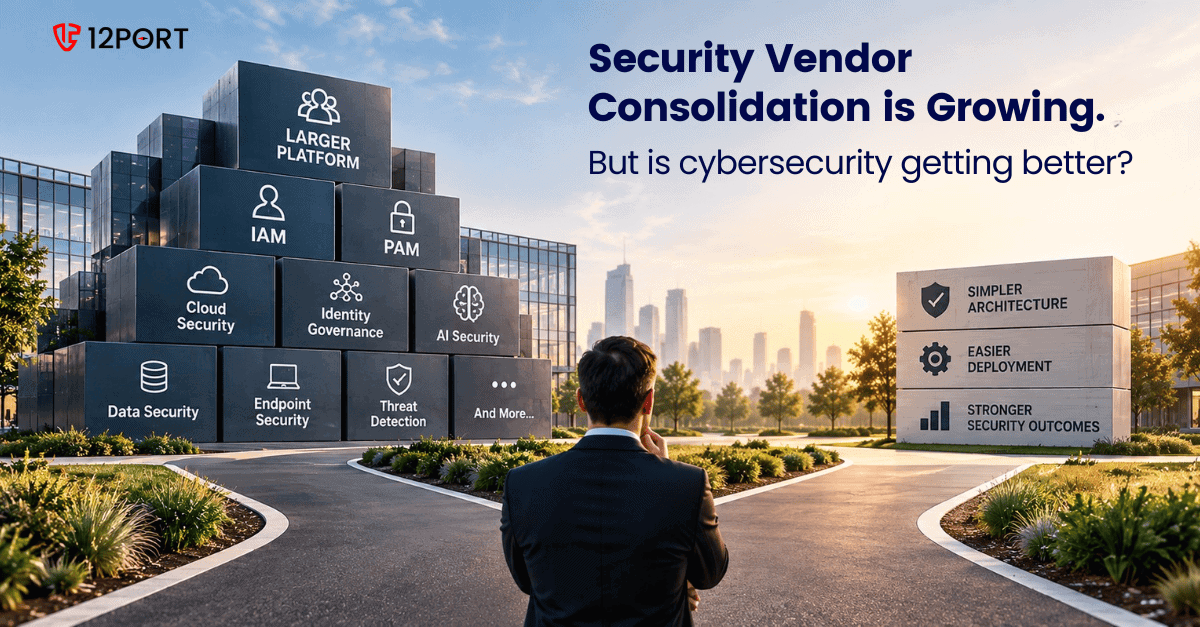
It certainly feels like the cybersecurity industry is entering another major consolidation cycle.
Large security vendors continue to acquire companies and build broader platforms. PAM vendor consolidation is part of this larger trend, with identity security becoming a particularly active area of investment and acquisition. SailPoint’s acquisition of Entro Security expanded its capabilities around non-human identities and AI agents. Palo Alto Networks’ acquisition of CyberArk brought identity security and PAM into one of the industry’s largest security platforms. CrowdStrike has also expanded through acquisitions across identity, browser and AI security. Within PAM, vendors including Delinea and BeyondTrust have used acquisitions to broaden their capabilities beyond traditional privileged access.
There may be a strong business case for these acquisitions. But the more interesting question for customers is whether these acquisitions and braoder platforms ultimately make their security programs better.
What Changes for the Customer?
There are obvious potential benefits. A larger vendor can bring greater resources, a broader ecosystem and tighter connections between security products. Working with fewer strategic vendors can also simplify procurement and vendor management.
But there are tradeoffs.
One is complexity. Consolidation is often sold as a way to simplify security, but acquiring multiple products doesn’t automatically make them one platform. If customers still have separate consoles, policies, workflows and architectures to manage, they may have fewer vendors without actually having a simpler environment. A broader platform also isn’t necessarily simpler if it requires more agents, infrastructure or operational overhead.
Pricing is another consideration. As products become part of larger platforms, licensing can change. Customers need to understand whether they can continue buying the capabilities they need or whether those capabilities become tied to additional products, bundles or platform commitments. Often times costs can increase.
Support and product investment can change as well. Larger companies may have more resources, but the acquired solution is also one part of a much broader portfolio. Customers should pay attention to whether the expertise, responsiveness and product investment they originally valued remain priorities.
This doesn’t mean acquisitions are bad for customers. But they can change the product, relationship and economics customers originally signed up for. This creates an opportunity to reassess current needs and determine whether the solution is still the right fit.
What PAM Vendor Consolidation Means for Customers
Privileged access management solutions are both mature and mission-critical. Enterprises have spent years building processes and controls around their PAM platforms, and replacing one is rarely a simple decision.
Given the recent acquisition activity across PAM market, many organizations may now find that the solution they originally selected is part of a much larger product portfolio or platform strategy. At the same time, machine identities, cloud infrastructure and AI agents are creating new privileged access requirements.
Whether privileged access is being used by an administrator, application, automation or AI agent, organizations still need to control that access, protect credentials, reduce standing privilege and understand what is happening.
For customers, the question is if the platform they have today makes those things easier and more effective. Does it simplify deployment and administration? Does it reduce infrastructure and operational overhead? Does it work with existing administrator workflows? Can it adapt to new requirements without another product or license? Are new capabilities truly integrated? Is the core PAM product continuing to improve?
Those questions matter more than the number of products a vendor can put on a platform diagram.
A Good Time to Reevaluate
Organizations shouldn’t replace a security product simply because its vendor was acquired. But a major acquisition is a reasonable time to revisit a decision that may have gone unquestioned for years.
Look at the product as if you were buying it today. Consider the architecture, complexity, cost, support and roadmap. Look at how well it fits your current environment, not the environment you had when you originally bought it. Determine whether the broader platform is actually solving problems for you or simply becoming larger.
What matters is whether the technology continues to solve the customer’s problem without adding unnecessary complexity or costs around it.
If your PAM solution was acquired, has the company, product strategy, pricing or support model changed since you first selected it?
If so, it may be time to ask a simple question: If you were selecting a privileged access management vendor today, would you still make the same choice?
A Modern Approach to PAM
12Port was built from the ground up for today’s privileged access challenges. Its agentless architecture secures and brokers privileged access without exposing credentials, while simplifying deployment and management across on-premises, cloud and isolated environments.
For organizations reevaluating an existing PAM platform, 12Port offers a modern approach designed to strengthen privileged access security without adding unnecessary complexity. Try 12Port today.
See 12Port for yourself
Drop your work email and we will reach out.
No spam. One follow-up, that’s it.